Showing posts with label book review. Show all posts

Wednesday, August 12, 2009

Book Review: Like Water For Chocolate

I picked this book off my shelf, and ended up reading it in a day. That being said, I came away from this novel with mixed feelings. I love Chicana literature, and the storytelling in this book was superb. Esquivel weaves the story around a twelve month cookbook, and you will be craving all kinds of flavors before the book is done. The connection between recipes and life is something I thought was fantastic--as different dishes really do conjure up specific memories for me. For example, homemade pickles reminds me of one summer my parents decided to try their hand at them in a house we lived on Logan St. in Portland when I was about twelve. Baked beans always remind me of my Grandmother Weatherspoon, as does Peppermint icecream . . . but back to the book. While the storytelling is beautiful, the language is rich, the characters believable . . . there is one reason that I have misgivings about the book. One of the main plot points has to do with infidelity. The main character is not allowed to marry her sweetheart, who then marries her sister just to be near her. Stupid plan if you ask me. They just should have eloped. But I didn't write the story. It isn't graphic, but the mere subject matter kind of made my stomache turn a bit.

One thing I did find very enjoyable and highly interesting was the matriarchy of the novel. Women dominate the book, and shape the comings and goings. It was interesting considering the machismo element of Mexican culture that the story comes completely from a woman-centered household. The main character first embraces, fights against, and ultimately reshapes this matriarchy, which is a very cool cycle. One reason this works is that the focul point of the text is the kitchen, which is one of the great symbols of domesticity.

Overall--I recommend the book. It isn't like Lolita where I felt that the author was a bit soulless . . . there is a moral center to the novel in spite of the infidelity. If you are a fan or a student of Chicana literature, you should definitely pick it up. I think there are some cultural mores that should be recognized going into the reading which make the book more enjoyable and worthwhile, especially as relating to machismo and Mexican Patriarchy. If you enjoy Sandra Cisneros, you would like this novel as well.

Thursday, February 26, 2009

Book Reviews

These stretch back all the way to when I was on bed rest, and had lots more time for reading. Nowadays, I try to balance a book on the boppy while I nurse, but the going is a little slower :o)

The Squatter and the Don is one of the first novels written by a Mexican American woman. Her style reminds me a lot of George Elliot, especially per Daniel Deronda where the prose is interjected by this kind of meta-narrative of philosophy or history. In this case, I feel she doesn't do it quite as seamlessly as Elliot because the characters seem rather flat, and more puppets for the point she is trying to make. The novel from a purely historical interest perspective did more for me than from a literature perspective to be honest, although I have a hard time extricating the history from the literature and vice versa: nobody writes in a vacuum. I knew the rough outline of what happened when California was annexed into the US and the resultant cultural displacement of the Mexican people, but this novel filled in a lot of gaps and provided a different perspective which I appreciated. I think that she definitely deserves a place in the canon, because while this wasn't my favorite novel for character development or outstanding, imaginative prose, De Burton has significant things to say and she does so with intelligence and grace.

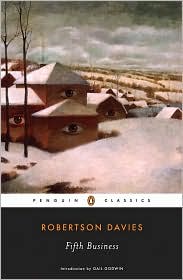
Fifth Business is a novel I actually started when I took a Canadian Lit course a few years ago (I was tricked into taking the class because the course was titled "ethnic literature" or something else misleading. It was a very disappointing class . . . both in material and instruction). True confession: never finished the book for the class but still got an A. Anyway, I picked up the book to give it another go because frankly I was too ill with the baby to make a trip to the library and I didn't have anything else to read. I must say that I did enjoy this novel better the second time around, although I still had a few issues with some of the author's characterizations. The feminist in me protested at the way he portrayed the women in his novel: there was too much angel/whore dichotomy in some (the narrator actually creates a "saint" out of one) and in general they are given very little autonomy or understanding. Davies does explore some interesting themes--such as the nature of our roles in this life (whether you are the main character of the "play" or merely fifth business-a kind of enabler role) as well as the nature of miracles and personal relationships. There are some charming characters as well as very imaginative ones . . . but the overall feel I got from this book was dissatisfaction. Perhaps I didn't appreciate this book fully because of my reading strategies: I have a hard time not reading from a feminist/Marxist perspective. If you read from either a Freudian or Jungian perspective, you may enjoy it more. Or if you read from just a readers response . . . you may have a better shot. If anyone out there disagrees with me, I would be interested to hear your perspective on the novel. Maybe I'm just missing something, and should give it yet another shot. Although I have a few other hundred novels in my queue I think I'd rather tackle first . . .

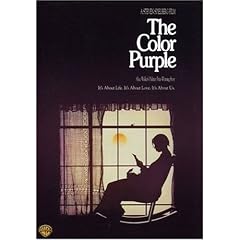
In this novel, I was not disappointed. Alice Walker does an outstanding job of creating complex, interesting, and sympathetic characters that grow and struggle . . . and sometimes overcome. This book had me thinking, and feeling, and I couldn't put it down. I guess this isn't such a big surprise since this was the genre I became most interested in while I was studying at University. There are psychological questions that come into play--from the many faceted ways the main character responds to the abuse she experienced, to the way Black masculinity is portrayed, to the nature of love and how we love. I felt that this book deserves the praise it has received . . . and transcends the movie that was made about it. Although Oprah was pretty funny for once. There is so much more that I could say about this book, but with the time and energy and mental capacity I have at this moment I couldn't do it justice (ask me again in a few months when my baby is sleeping through the night) so I will leave it at this-- Good Read.

While I was on bed rest, my mom let me borrow a copy of Left to Tell to pass some of the tedium on the couch. This was one case where I recommend skipping the forward and just reading the book. In my personal opinion the guru who wrote the forward was kind of weird and creepy . . . but maybe that was just the terbutaline talking. Anyway--Left to Tell is a non-fiction account of a survivor of the genocide that happened in Rwanda during the ethnic wars between the Hutus and the Tutsis. She is a woman of great faith who relies completely on her belief in God to get her through the terror she experienced and the subsequent loss. I had mixed feelings after reading the book. I wasn't as profoundly moved perhaps as many of the people I have heard praise the book. I do have deep admiration for her moral courage and her emotional strength, as well as the humanitarian work and goodwill she promotes. Spirituality is a difficult thing to convey in words, because it is such an intensely personal experience, so it can be difficult to translate--especially when not writing in your native language. Still, it was a good book, and I do recommend it.

Jonathan Rosen is one of my favorite authors--and guess what Randy, he's a white male! (My husband doesn't seem to think I can appreciate an author unless they are, as he puts it, "ethnically oppressed.") Rosen is a Jewish writer from New York, who really hasn't written as much as I would like :o). He does have a fairly new book out that is non-fiction about birdwatching, and if anyone could get me to read a book about birdwatching, it is Rosen. Joy Comes in the Morning is his first novel, and while I didn't enjoy it quite as much as Eve's Apple, I still think it is a very good work. Joy weaves together the experiences of an ailing man who is a holocaust survivor but attempts suicide to prevent living like a vegetable after a stroke, his son and a female rabbi. His characters are real, his prose is engaging, and I actually didn't resent the way he portrayed his female main character. What I think I appreciated most about this novel was the conversation about faith, and what it means to live "religiously" and still authentically. While I disagreed with some of the theological premises of some of the characters (particularly in the areas of premarital sex), I found the conversation itself worthwhile. This was another book I couldn't put down, and made me feel inspired in my own writing--which is far too sparse these days.

Thursday, July 3, 2008

Book Reviews


So one activity I have been up to enjoying while in between being asleep and/or puking my guts out for the last few months has been reading. It was kind of nice to catch up on all the books that I had bought over the last few years and never had the time to read. I am reaching a dangerous zone though . . . I have only one or two more books before I will be wanting to hit the bookstores . . .

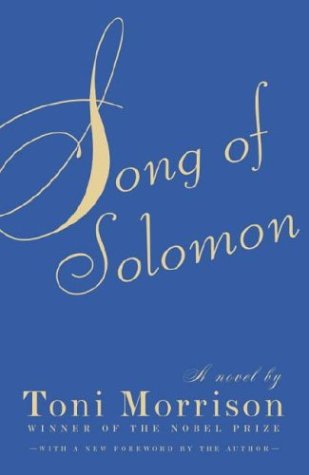
I first read Toni Morrison's work in my post-modern American lit class a couple of summers ago when we read Jazz. I expected to be impressed with her work, which I was, and had been meaning to read more of her work but hadn't until I picked up this book. This was a slight departure for her because she takes on a masculine viewpoint for the majority of the work. The title is bit misleading--it references not the Judeo-Christian biblical Solomon and his love poetry that has been debatable in the Canon for centuries--but a colloquial children's song recited by youngsters in the deep south. I once heard Morrison described as a historical revisionist, not in the sense you may be familiar with where crazy people believe there was no Holocaust etc, but the term applies to her in the sense that where history has been written by the "winners," she has attempted to open up a past that has been largely without a voice. The novel opens up in 1930's Michigan, and spans into the 1960's. The heart of this novel is a journey of self-discovery for a man who is emotionally isolated, disconnected--both from the people that ought to be the most important to him, as well as his cultural and familial history. The book takes on issues of race and justice, as well as socio-economic struggles for blacks both with and without money. In this novel her characters are disturbed, searching individuals--and most of the time the main character, Milkman dead, is not a likeable fellow. But what makes this work great is her storytelling ability (I was reminded a lot of the tradition of Zora Neale Hurston) and the power of a cultural and family past over a person and their destiny. I recommend this book to anyone who has read/enjoyed Toni Morrison in the past, or that is interested in African-American literature. It is a tragedy, so don't approach this book with expectations of anything lighthearted or a simple "fun read." It is complicated, at times disturbing, but worth it.

This book I came away from with very mixed feelings. In a nutshell: Nabokov is without a doubt one of the most talented writers I have ever encountered. But after reading his work and some articles written by him about his work and purpose for writing, I have some significant issues with him. I read this book because it is on all the lists for the greatest works of the twentieth century, and I was further interested after having read Azar Nafisi's book, Reading Lolita in Tehran (which is not all about Lolita, they cover many major works including Pride and Prejudice. I highly recommend Nafisi's book by the way). Most people are familiar with the basic concept of Lolita so I won't get into many of the disturbing details of the plot--basically it is about a man who is obsessed with young girls and who kidnaps a young girl of about 14. She does escape by the way. Anyway, I would not recommend this book to many people. If you are a serious student of literature and have been trained to read books like this, then go ahead. Nabokov is without question a masterful writer. I simply disagree with his purpose for writing. I quote, "I am neither a reader nor a writer of didactic fiction, and despite John Ray's assertion, Lolita has no moral in tow. For me a work of fiction exists only insofar as it affords me what I shall bluntly call aesthetic bliss, that is a sense of being somehow, somewhere, connected with other states of being where art . . . is the norm" (Nabokov 314). I also do not like "didactic" fiction, but I feel that Nabokov confuses such fiction for any narrative with a moral center. This disturbing subject I believe he took on simply as an exercise in art--to see if he could pull of something that no one else has. I am more of a proponent of William Faulkner's view on literature, which he elaborates on in his famous Nobel Prize winning acceptance speech. Here is a link-- I highly recommend reading it http://nobelprize.org/nobel_prizes/literature/laureates/1949/faulkner-speech.html

After reading Lolita which I found to be a rather depressing work, I needed something of a pick-me-up. I had read Erdrich's novel, The Last Report on the Miracles at Little No Horse so I knew and enjoyed her writing style. I was not disappointed in this novel at all. Erdrich possesses such a charming prose style that is simply put GREAT storytelling. She is a Native American author and so she draws on fascinating lore and folk tales that had me completely enraptured. Her characters span across many of her novels--there is a family tree you can follow between many of her different works. I recognized many of the characters from the book of hers that I had read previously, but the subject matter wasn't tired or contrived. She manages to tell a fresh and interesting story of love, forgiveness, revenge, and ultimately a story of finding identity. It is a relatively short novel, only about 200 pages, and one I highly recommend. I warn you though, her novels are rather addictive. I am now going to have to read the rest of her works . . . again Randy had better keep me away from the bookstore . . .


This next book I probably would never have picked up except that it was sent to me by this book club that I used to have a membership in. This was a very early effort by Capote (most famous for his novella "Breakfast at Tiffany's" and his groundbreaking work In Cold Blood) so it isn't as polished as some of his other works. I knew going into this book that Capote was a very interesting character himself, but this work surprised me--especially the ending. In any case, it was a very short read--I think I read it in an evening--and I probably won't pick it up again. Granted, it isn't really my niche in literature (white, male, privileged) but aside from that the style and the character development just didn't really do it for me. I am interested in reading In Cold Blood in the future, but aside from this and the other short works I've read by him in the past, I think my Capote limit in literature has been met. If anyone out there disagrees with me, feel free to offer reading suggestions and I will take you up on it.

This book I read because 1. It had been sent to me by the aforementioned book club, so it was on my shelf and 2. I was slightly curious to see what all the fuss was about. I had heard one scathing review by one of my literature professors, Zina Peterson (who happens to be Hugh Nibley's daughter, and pretty much just as brilliant) who gave us a fifteen minute impromptu lecture about the time this novel was big about why she and her father thought this book was complete nonsense, badly researched, etc. So while most of the world has read this book by now and I know it is completely old news, I picked it up anyway. Plus when you don't feel well enough to go to the library, the phonebook starts to look entertaining. In any case, I agree for the most part with my lit professor. It isn't great literature, it is at most entertaining on the level of a great many "best-sellers" of the action/intrigue variety that get made into major motion pictures. The most interesting parts to me were the symbology explanations and the codes, although coming from the theological and ontological background that I have, I tend to arrive at rather different conclusions than the author puts forth. I have always been fascinated by how what I view as eternal truth or pure religion has been mangled and transformed over the years, and found its way into various belief systems and epistemologies. It is interesting for me to see how what I view as truth has been interpreted by other people and other faiths very differently. In any case, as long as you go into this book with a firm grasp that this is indeed fiction, (Mr. Brown in his introductory notes would have you believe that this work is closer to life than fiction) I wouldn't mind recommending it as an easy summer read. But on the other hand, there is so much GREAT fiction out there, why waste your time on the mediocre? Unless of course you are in bed sick, counting the ceiling tiles . . .

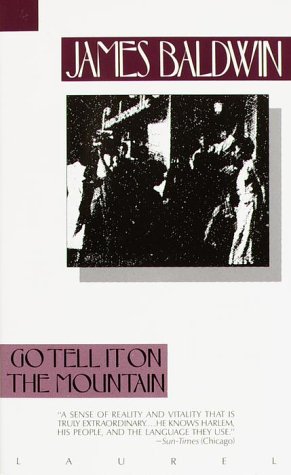
And last but not least, I read Baldwin's famous novel, Go Tell it On The Mountain which was really unexpected and interesting to me. I'm not sure I know what I expected going into this book, other than a vague perception that it might be somehow akin to Native Son or Invisible Man. Instead, I found myself thrown into a pentecostal revival that reminded me so much of my experiences on my mission with the black folk in the Galveston projects. This book is all about religious fervor, self-discovery, faith, intermixed with race and social issues. Baldwin's writing style is very engaging, colorful, and full of life. It sweeps you up with the characters, good and bad alike, and shifts perspectives back and forth to offer rounded viewpoints of who these people are, and how they became the way they are. The ending left me a little hanging, but I wouldn't have had it any other way. This novel is a powerful window into the black experience of mid-twentieth century Harlem, and I would recommend pairing this read with Lorraine Hansberry's "A Raisin in the Sun."

Thursday, February 21, 2008

Book Review: Praisesong for the Widow

Praisesong is the first novel I have read by Paule Marshall. Through the course of my studies in African American Women's Literature, I have read various pieces of criticism by and about Paule Marshall, but I had yet to get around to her literature. I picked this book up two days ago (my bookshelves are filled with books I am anxious to read) and I have been enthralled from start to finish. As I read her work I was reminded of the experiences I had reading other books, such as Mama Day by Gloria Naylor, and Their Eyes Were Watching God by Zora Neale Hurston. All these novels--all extremely moving and excellent fiction--deal with ancestory, love, and destiny--and how these three things are irrevocably intertwined. Marshall does a fabulous job of keeping her narrative focused and relavent, all the while creating a deep dreamlike environment for the reader to lose themselves and experience another world. I love reading books like this so much because they make me feel connected to the diaspora of humanity, with the universal nature of feminism, with empathy, with experiences that are not mine but that I can still connect to.

Praisesong takes the familiar situation that Lorraine Hansberry captured in her play, "A Raisin in the Sun," of an underprivilaged black family living in abstract poverty, and then finishes the story where Hansberry left off. What happens to us when we let our circumstances dictate who and what we are, instead of letting the most fundamental part of our souls thrive, no matter our circumstances, good or bad--rich or poor? Richard Wright answered that question for himself in Native Son, with a polemic that is intended to be at once terrifying and real. Marshall does not take up the same themes of overt violence, the "ego" gone out of control--but she captures something very powerful in a very feminine way.

I highly recommend this book. You would definitely like it if you like anything by Toni Morrisson, Zora Neale Hurston, or Gloria Naylor.

Monday, February 11, 2008

January Book Reviews

After a long drought of reading for me (Christmas projects took up all my spare moments in late November/all of December) I devoured a couple of books last month. They are both best sellers and one won the Pulitzer, so I thought I'd review them for those of you in to literature.

Evening by Susan Minot was beautifully written. I was familiar with the film version that came out to limited release this last year (the screenplay was done by Michael Cunningham, and was materially different than the book--still a fine film in its own right) and on the special features of the DVD (thank you Redbox) I saw an interview with the author, and my interest was piqued. Her writing style is very spare--reminiscent of many of the mid 20th century author's styles (Hemmingway, Faulkner) but used in a very post-modern feminist way. Much of the prose reads like a kind of poetry--think Virginia Woolfe meets Sandra Cisneros--and I was fascinated and impressed with this poetic version of stream of consciousness. Overall I was very impressed with the quality of the novel. It dealt with very poignant issues without becoming overly sentimental, and I felt that the characters were believable and real--which I had been disappointed in a few of my previous reads. I would recommend this to people who can handle or even like novels with non-traditional prose, and don't mind shifts in time and/or perspective. If you like the novels The Heart is a Lonely Hunter by Carson McCullers or Caramelo by Sandra Cisneros, I think you would like Evening.
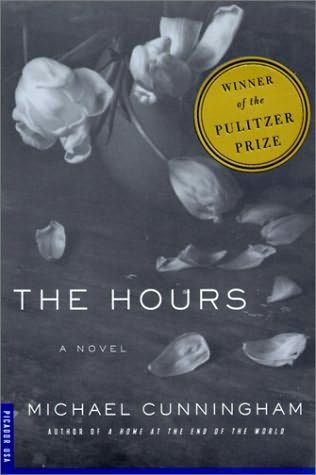
The next book I picked up was related by the association of the two authors--Michael Cunningham wrote the screenplay for Evening, and I was familiar with the film version of The Hours. I studied Virginia Woolfe a fair amount in various British Literature courses, and I firmly believe that before either seeing the movie or reading the book, a familiarity with Woolfe's Mrs. Dalloway is absolutely necessary. First of all, Mrs. Dalloway is a spectacular piece of fiction--Woolfe's language is exquisite and I think the concept of the novel is pure genius. Cunningham does a superb job of capturing many of the elements from Dalloway in The Hours--and to get the full effect you really must read the book. Something that might turn some people off to the novel: Michael Cunningham deals extensively with homosexuality in his work. As a gay writer he sees the world from that perspective, and it is an obvious factor in his work. I studied enough "queer theory" (yes, that is the technical term for it) in my university studies not to be fazed by homosexual themes/characters--so I thoroughly enjoyed the novel. It was very well written, and I wholeheartedly agree that it deserved the Pulitzer. Having given that footnote about Cunningham's . . . gayness . . . if that is what you want to call it, The Hours isn't about homosexuality. It is about dealing with loss, living with mental illness, love, and what the price is of living a full life. The themes are deep and very relevant for all of us, no matter our religious affiliation or sexual orientation. If you liked the novels Possession by A.S. Byatt or Eve's Apple by Jonathan Rosen, I think you would enjoy this novel.

Monday, October 8, 2007

Book Review: Possession by A. S. Byatt


I am going to pull a little copycat here, and do a book review of the latest one I've read. Possession is fantastic--especially if you are into literary fiction. It is poetic--literally--she mimics the British romantic poetry (Romantic being a literary period like modern or Victorian, not indicative of subject matter) of Browning, Barrett and Wordsworth as she creates fictive literary greats of the eighteenth century. It slips in and out of modern life and eighteenth century life seamlessly. Her characters are believable, and her prose is absolutely gorgeous. I am excited to read more of her work, because I feel like I just stumbled upon something really great! For the light reader: She does get into literary theory--psychoanalysis, the French feminists like Cixous, as well as a little queer theory (that isn't a pejorative phrase, that's really what the scholarly field is called) because that is what her characters are dealing with. She makes them very believable scholars, so if that turns you off you probably wouldn't appreciate the book. It isn't too heavy with theory, but it is an element. Something I was fascinated with while reading this novel was all the reference to Norse mythology in the poetry of her characters. I'm not a mythology buff so I borrowed an Oxford edition from an old roommate and learning a little bit more. The mark of a good book for me is not merely that it grips me--which this one did--but that it actually inspires me--which this one did as well. I feel like a better writer, scholar and critical thinker for having read this work.