Showing posts with label literature. Show all posts

Sunday, October 4, 2009

Welcome to the Bloomsbury Cafe!

I really miss being part of an English literature department. I love books, I love putting them in conversation with other books, and I love discussing these threads of thought with other people. When we can afford both the time and money for me to do so, I want to go back to graduate school. I even found an online program through an accredited university . . . but that is for another day. For now, I have founded an online "cafe," where we will be discussing one book every four months, rotating between four friends who will pick the book and host the discussion. The first book that we will be reading is . . .
NPR has a great article and a podcast of Morrisson reading the novel here. My copy is on its way from Amazon, and I am so excited to start reading and studying again. There are superficial readings, and then there are readings that help me change the way I think, open my mind to new ways of knowing, make me see the world and people in different ways.

Plus, it is a wonderful opportunity to spend "virtual" time with some of my favorite people in my little virtual coffee shop/bookstore that I have always dreamed about. Here are my literary companions (please check out their blogs, they are wonderful, beautiful, smart girls!)
:
1. Name: Krystal Nanette Downs (http://krystaldowns.blogspot.com)

2. Favorite place you have lived: Camarillo, California

3. Place you would like to live if you could: Can I pick more than one? Ireland. Southern California. Italy.

4. What do you do when you aren't reading? I WORK. Right now I have a full-time job and and what feels like a full-time internship. When I have the occasional spare moment, I enjoy swimming, riding my bike, going to bookstores (that doesn't count right?), dancing, listening to a wide array of music, laying in the sun, meeting new people, traveling, watching trashy T.V. shows, and going to the beach if I'm near one.

5. 3 favorite films: Right now they are: Fargo,The Hours, The Departed

6. 3 favorite foods: Sushi, fruit, Indian

7. Major, specialty in major if any: English. Minors: sociology and women's studies

8. Favorite literary time period: Post-modern lit/post 1950's.

9. 3 favorite books and why: 3 favorites! Well if I have to choose...

God of Small Things by A. Roy. I read this book a long time ago, and so cannot completely explain why I love this book so much. I always loved the fairy tale type storytelling that one find in Indian literature, so I know that is part of it. I remember this book touching me on so many different levels. It was one of those books that stays with you long after you read the last line. I love Roy's language that seems playful and tragic. So many simple phrases knocked me down with their power. She breaks all the rules of language in all the right ways. Her moral judgements on her characters are clear and brutal. And her judgements on her readers are unbending; not once was I allowed to break free from her words and the critique behind them.

Here is an excerpt: "Perhaps it's true that things can change in a day. That a few dozen hours can affect the outcome of whole lifetimes. And that when they do, those few dozen hours, like the salvaged remains of a burned house---the charred clock, the singed photograph, the scorched furniture---must be resurrected from the ruins and examined. Preserved. Accounted for. Little events, ordinary things, smashed and reconstitutred. Imbued with new meaning. Suddenly they become the bleached bones of a story." AWESOME!

Anna Karenina by Tolstoy

I took a Russian Literature class while at BYU and loved it. It gave me an excuse to read so many brilliant books. I had read Anna Karenina on my own before, but fell in love with it the second time around. The characters are all so hopeless; I wanted to shake them all and say look at what you're doing, ruining your life, for what? In this case, most of the characters are ruined because of love or at least what looks like love. My favorite character by far is Levin who is always searching for something, be it truth or love, and never can seem to find it.

His thoughts and speeches are so remarkably poignant, that when I was reading the novel I wanted to underline everything. That is how quotable Anna Karenina is.

Lolita by Nabakov

I know Alicia is squirming right now. I really do love this book though. Yes, the characters and themes are a little disturbing. But I love his writing more than almost anyone else I've read. I feel like each of Nabakov's sentences are words of poetry. He makes pedophilia, incest, and the most vile and disgusting sound and look beautiful. You can really see that he is a true master of language.

Just listen to his genius first lines: Lolita, light of my life, fire of my loins. My sin, my soul. Lo-lee-ta: the tip of the tongue taking a trip of three steps down the palate to tap, at three, on the teeth. Lo. Lee. Ta. She was Lo, plain Lo, in the morning, standing four feet ten in one sock. She was Lola in slacks. She was Dolly at school. She was Dolores on the dotted line. But in my arms she was always Lolita. Did she have a precursor? She did, indeed she did. In point of fact, there might have been no Lolita at all had I not loved, one summer, an initial girl-child. In a princedom by the sea. Oh when? About as many years before Lolita was born as my age was that summer. You can always count on a murderer for a fancy prose style. Ladies and gentlemen of the jury, exhibit number one is what the seraphs, the misinformed, simple, noble-winged seraphs, envied. Look at this tangle of thorns.

Nabokov would always tell people that he thought in images and that letters and words for him were colored (literally). Not surprising considering language like the above, no?

10. How do you like to approach literature? Do you have a particular reading strategy you usually employ? My inclinations push me towards a feminist approach, although I do think that if one is a true critical reader, one must look at literature from many, if not all, modes of reading. I also have a deep love of Marxist criticism. Down with the man!

One of the specific strategies I like to employ is a kind of reader response. If I find something profound, I highlight it. If I have a thought that needs out, I write it down in the margins. These notations often help me connect previous concepts to current and future themes.

11. What does literature "do" for you? Or in other words, why spend the time? My love of books began at a very early age. I used to love to read simply for the juvenile pleasure of it. Now that I am much older and wiser :) books mean so much more to me. Books make the world seem smaller, they make the differences between people seem insignificant. Reading connects me to experiences and feelings I might not have felt had it not been for a book or character. Literature pushes me to think critically, to challenge norms, to question authorities and truths. Literature makes the small things big. It makes me and you and everyone significant. It makes us all beautiful.

12. The really big question--how do you know Alicia? I met Alicia my Junior year of college (Fall 2006) when I moved into the condo at Victoria Place II. She was my room roommate. I was constantly amazed that I had got so lucky; we both got along extremely well, and were both English majors. She would give me advice about what professors to take classes from, and was continually encouraging me to be and do better. I really enjoyed being her roommate for that semester.


1. Name: Megan Elizabeth Welton (let's pretend I wasn't named for a rather whorish character in a book my parents read and say I was named for one of my favorite Austen heroines).
(http://do-what-now.blogspot.com)

2. Favorite place you have lived: The Avenues of Salt Lake City (followed closely by in the same room as Alicia and across the hall from Krystal).

3. Place you would like to live if you could. In Kate Winslet's cottage in The Holiday. If memory serves, it was in Surrey. Jude Law has an open invitation to stay whenever he feels the least bit drunk from a night at the pub.

4. What do you do when you aren't reading? I usually watch TV or go swimming or find something delicious to eat. I spend a lot of time reading though, now that it's my profession.

5. 3 favorite films:
Sense and Sensibility and Pride and Prejudice (it's a tie).
Enchanted April
Ocean's 11

Though, I will say that my favorite genre is "Biopic Movies about British Authors, Particularly if They End Tragically."


6. 3 favorite foods:
Cadbury chocolate
Fresh, grilled salmon
Almost any breakfast

7. Major, specialty in major if any: English, with an emphasis in technical writing and a minor in editing

8. Favorite literary time period: Early to mid 19th Century British Lit.

9. 3 favorite books and why:

1. Anything Austen, though Pride and Prejudice has been my favorite longest. I grew up with these books and they managed to grow up with me. I think the writing is at the same time brilliantly clever and flawed.

2. City of Glass by Paul Auster. This was my first taste of my second favorite literary period, which is postmodern American. It flirts with the lines of identity and reality in a great way that left me confused, and gives me a headache if I think of it too long.

3. The Giver by Lois Lowry. I think I first read this book when I was twelve, but didn't really read it until I was about finished with high school. It's the most adult young adult book I've ever read. Genius.

Bonus: Harry Potter. Okay, so sure, these books may not be high-brow works of art, and I'm by no means a fanatic, but I really appreciate the fact that I can constantly find new themes in the stories, and the plot structure and the actual telling of the story were masterfully accomplished.

10. How do you like to approach literature? Do you have a particular reading strategy you usually employ?

It depends on the book. But I learned a lot about reading in my postmodern class. For me, it's nearly impossible to do a close reading the first go around, so I tend to read quickly the first time just to get through, and in so doing I can generally find the overarching theme or purpose of the story. But if I were to read Eliot's Middlemarch, I'd take my sweet time, and probably do a little research as I'm going, to get a cultural and historical context of the book. Generally though, I read for enjoyment first, since I'm not getting graded any more.

11. What does literature "do" for you? Or in other words, why spend the time?

First and foremost, literature is an escape. I've always read to escape stress or fear or loneliness. Second, I love literature that challenges me to broaden my perspective. Third, reading helps me be a better conversationalist, which is important to me, since I love to entertain. Fourth, one day I hope to grow up to be a good writer. And as an editor, I've discovered there is a vast difference between writers who read, and writers who don't.

12. The really big question--how do you know Alicia?

I was her favorite roommate ever, since I made her laugh so hard so often that she didn't need to do a single ab crunch while living with me.


1. Name: Kristi Peters Millett (http://poetryinembryo.blogspot.com)

2. Favorite place you have lived: Williamsburg, VA (where I am now), though I suspect most places on the East Coast would work just as well--I adore the East Coast.

3. Place you would like to live if you could: London. No question. They have sarcastic window displays--show me a better definition of contentment.

4. What do you do when you aren't reading?: I handle scheduling, publicity, and a desk at the College of William & Mary Music Department. When not at work I enjoy attending performance events (Medieval instruments, Performance Art, a Jazz trio, Shakespeare, a Symphony, or Deathcab for Cutie--whatever really as long as it's well done), staring like a love-struck freshman into my husband's eyes, trying on clothes at Banana Republic, preaching the Gospel of Barack Obama, and not writing my poetry. When I don't want to think I watch HGTV :). David Bromstead is a magician.

5. 3 favorite films: Much Ado About Nothing (1993), The Incredibles, Stranger than Fiction AND (I'm a cheater) The Hours, The Matrix, Shakespeare in Love, Nick and Norah's Infinite Playlist, Beauty and the Beast (Disney), Pride and Prejudice (2006) ok I'll stop now :).

6. 3 favorite foods: 5 Guys french fries, real Italian chocolate gelato, most non-seafood Italian pasta dishes

7. Major, specialty in major if any: English with emphases in theatre and poetry (my first majors were Theatre and then Political Science before I found the one true path)

8. Favorite literary time period: oooh that's hard...probably American Modernism--good stuff, especially the poetry. I hope you're happy making me pick--I feel like I just flipped off Pablo Neruda...

9. 3 favorite books and why: I'm not really going to list anything particularly unique here--I've read many things that I've loved and thoroughly respected, but the following are the books that just kept me.
A. The Great Gatsby by F. Scott Fitzgerald. This is the first novel that did more than just pass the time for me. It's also, I suppose, the first "sad" book I ever connected with. I had always loved reading and writing, but this book, at the age of 15, really showed me what literature could be and how it can move people, how it can stay with you always. The devastation of human apathy continues to be a favorite motif of mine.
B. A Coney Island of the Mind by Ferlinghetti. Beyond being good Beat poetry it's just damn good period and simply must be heard.
C. Mrs. Dalloway by Virginia Woolf. Quite frankly, I still don't know specifically why I love this piece so much. Just mentioning it now, though, makes me want to read it again. I'll never be sick of it, every time I tear through it I'm affected. In my opinion, it's by far the best of Woolf's works and a masterpiece of our language.
D. Pride and Prejudice by Jane Austen. I can't help adding this one too :). Nothing cheers me up faster, and has there ever been a more fantastic read? Austen's characters are deliciously concrete and there will never be a more perfect couple than Lizzie and Darcy. Never ever.


10. How do you like to approach literature? Do you have a particular reading strategy you usually employ?: I don't dig into novels as much as I used to--I attempt (attempt) to not dissect them too much on the first read through at least and just let them wash over me. When I do analyze, I tend to do so a bit politically with a lot of feminist analysis. I've also always enjoyed New Historicism. With poetry I re-read a lot, silently and out loud--there is always another facet or layer to a good poem--something I can learn.

11. What does literature "do" for you? Or in other words, why spend the time?: I couldn't do without it. I need the intercourse of ideas. I can think of no better way to converse directly with humanity. Often when we speak to our contemporaries we miss the larger context of who we are, but when we read and write we are at once speaking with those who came before us and those who will come after us. When we read we come closer to understanding the inscrutable private motivations of not only other people, but other times and cultures. I describe poetry as recreating an emotional moment inside another person, and that in essence is what the process of making literature is to me: step by step moving closer to perfect communication and understanding. It's fantastic.

12. The really big question--how do you know Alicia?: English classes at BYU! I might get this wrong, but I think our first one together was Kristen Matthew's 293 class? I just adored, Alicia: complicated without being needy, intelligent without being pretentious, she was well-read and an excellent conversationalist. We edited each other's work and helped each other through a few drama-full semesters. She was and is a good friend :).
Name: Alicia Johnson

Favorite Place I have lived: My favorite city is probably Portland, OR. It is absolutely gorgeous, you don't have to pump your own gas, there is no sales tax, and I love the cultural atmosphere. Plus you are like an hour from the mountains, and an hour from the beach.

Place I would live if I could: England. Without a doubt. I would have to ship my parents there as well, but definitely England.

What do you do when you aren't reading: Change lots of diapers, wash and fold diapers, ha ha. I love spending time with my family, hiking and camping (when I can get Randy to come with me--he's afraid of the bugs and the dirt), knitting and sewing, writing (when I can get my brain collected enough to produce lucid thoughts)

3 Favorite Films: Roman Holiday, Emma (the Gwyneth Paltrow version), Casino Royale (Randy just came in and reminded me that I need a good extended-version Lord of the Rings fix about every year, so throw that on the list as well . . . )

3 Favorite Foods: really good chocolate, Pesto Gnocci with foccassia bread and fresh grape juice, Indian curry (I like lots of food--it's hard to narrow)

Major, Specialty if any: English literature--my emphasis was on women's ethnic literature (mostly black and Chicana)

Favorite Literary Time Period: My focus has been on mostly American modern and post-modern women's lit, although I also really enjoy the British Romantics (Austen, Brontes etc) and the British moderns (Yeats, Elliot) and Post-colonials.

3 Favorite Books and Why: The Oxford Complete Yeats. I am pretty much in love with Yeats--his poetry, his drama, his eccentric way of thought. He was brilliant and incredulous his whole life. He never stopped searching for answers and truth and beauty, and I really admire that.

Possession, by A. S. Byat. The text is beautiful, the characters' journeys are amazing. I couldn't put it down. Plus it was written by a literary nerd so it was full of theory and complexity, so I was in heaven.

The last one isn't in book form yet, but I hope it will be. I worked with a professor compiling the complete works of Lorraine Hansberry, and I completely fell in love with her. She is best known for her play, A Raisin in the Sun, but she wrote poetry, articles, and other plays as well. A tiny overview of some of her other works are found in the volume, To Be Young, Gifted and Black.

How do you like to approach literature? Do you have a particular reading strategy that you employ? I approach most of my reading through a Marxist/feminist lense, but I particularly enjoy American Studies approaches as well as reader-response. Certain books really call for certian theories (it is hard to read something like The Hours without using Queer Theory for example). But generally speaking, I go through the good old feminist approach.

What does literature "do" for you? Or in other words, why spend the time? Literature helps me understand other points of view, opens my mind to new ideas, helps me consider the world around me and my place in it. I think literature has great power for good in enabling us to learn in an objective manner that we might not otherwise be open to. As long as ones time is spent reading quality things, I think that one can gain a great deal of knowledge and compassion for people and the world in general. Plus--it is really fun to just get lost in a good story!

I am goint to alter the last question a little to suit me. What I love about Krystal, Megan and Kristi: Krystal is very bright, impassioned, knowledgable and compassionate. She is open to new ideas and tolerant of those who disagree with her standpoints. She is creative and one of my favorite people to talk to, especially about difficult subjects. Megan is so darn fun, I can't even stand it. She is a great storyteller- if you get her going she will make you lose control of your bladder. Plus she is very smart and has great taste in books and movies, so she is great to have around. Kristi is one of my few friends who doesn't believe that poetry is dead--which is a completely refreshing quality to have in a friend. I can talk to her about a wide range of the arts and she always has interesting things to say and new ways of looking at things. Plus she is tolerant of new ideas and has a sense of adventure that I really admire. She helped me get through a couple of very emotional semesters--a very good friend.


So, there you have it--the girls of the Bloomsbury Cafe. It would be wonderful if anyone out there reads along and joins in the conversation. We hope to publish on our blogs an article a month about the books we are currently reading.

Happy reading!

Thursday, March 19, 2009

Tess: A Modern Heroine

I am currently reading Tess of the d'Urbervilles by Thomas Hardy (really, I should have the review done next week) and I came across this quote by the author as narrator, describing his heroine, "She was expressing in her own native phrases--assisted a little by her Sixth Standard training--feelings which might almost have been called those of the age--the ache of modernism." This is in reference to a passage where Tess tells Angel, "And you seem to see numbers of tomorrows just all in a line, the first of them the biggest and clearest, the others getting smaller and smaller as they stand farther away; but they all seem very fierce and cruel and as if they said, 'I'm coming! Beware of me!' . . . "

I never thought of Tess as a "Modern" character before now. Hardy published Tess toward the end of the Victorian age--but still well within it. Yet she does pre-date some of the modern feelings of discontent, disillusionment and conflict seen across the western world in the decades to follow.

Marx wrote about the modern world, "In our days everything seems pregnant with its contrary.” The same could be said of Tess, who inspired such fierce criticism as well as praise by the Victorian world. I think it is the contrairies in Tess that continue to make her an intriguing character for contermporary audiences. She was neither an angel nor a whore--she was a good woman who lived through incredibly difficult experiences and in the end succumbed to them.

Marx further states, "All that is solid melts into air, all that is holy is profaned, and men at last are forced to face . . . the real conditions of their lives and their relations with their fellow men.” Tess certainly challenged the assumptions of the world in which Hardy introduced her--indeed I believe she continues to challenge the close reader of the text today with the complexity of her character. When she takes it upon herself to baptize her own infant, she at once contradicts the church and reaffirms her faith in it--a complex moral conundrum that theologians have puzzled over to which she finds a straightforward, "modern" approach.

Marshall Berman described the Marxist approach to contemporary life as, “ironic and contradictory, polyphonic and dialectical, denouncing modern life in the name of values that modernity itself has created, hoping–often against hope–that the modernities of tomorrow and the day after tomorrow will heal the wounds that wreck the modern men and women today.” Tess, a modern heroine juxtaposed against the ancients of her family--those fallen d'Urbervilles who haunt her throughout the novel and contribute to her downfall--can be seen throughout the novel adapting, hoping for the "modernities of tomorrow" to help her solve the problems of yesterday that linger into her present.

For those who have read the novel, how does Tess speak to you as a "modern" character? Do you think she fulfills the definition of modernity, or is she still a product of Victorian society?

Thursday, March 12, 2009

Greatest Novels of the 20th Century

I have seen recently a few lists roaming around facebook and different people's blogs of books people "should" read. For example, one was a BBC list that claimed most had never read 6 or more titles off the list. I wasn't very impressed with the compilation--I love Harry Potter as well as the next person, but I wouldn't put it up in a league with Faulkner or Morrisson. Anyway--here is a list that I like to go by compiled by The Modern Library--as far as it goes (the whole idea of a single "canon" is itself a little repugnant to me: but as far as trying new things, here is a good reference). Just for fun, I've added a star next to the ones I've read. Now, if the anthology was of women's lit or of African American lit, I'd fare a little better!

  1. ULYSSES by James Joyce * This is a novel you really should have a reading guide for
  2. THE GREAT GATSBY by F. Scott Fitzgerald *
  3. A PORTRAIT OF THE ARTIST AS A YOUNG MAN by James Joyce *
  4. LOLITA by Vladimir Nabokov * see my review here
  5. BRAVE NEW WORLD by Aldous Huxley
  6. THE SOUND AND THE FURY by William Faulkner * Point of trivia-- Toni Morrisson is a Faulkner expert, and wrote her dissertation on him.
  7. CATCH-22
  8. DARKNESS AT NOON by Arthur Koestler
  9. SONS AND LOVERS by D.H. Lawrence
  10. THE GRAPES OF WRATH by John Steinbeck * read exerpts, need to finish it
  11. UNDER THE VOLCANO by Malcolm Lowry
  12. THE WAY OF ALL FLESH by Samuel Butler
  13. 1984 by George Orwell
  14. I, CLAUDIUS by Robert Graves
  15. TO THE LIGHTHOUSE by Virginia Woolf * Honestly not my favorite Woolf--I'm a Mrs. Dalloway fan, but still a gorgeous novel.
  16. AN AMERICAN TRAGEDY by Theodore Dreiser
  17. THE HEART IS A LONELY HUNTER by Carson McCullers * (one of my favorites-- tragic and moving)
  18. SLAUGHTERHOUSE-FIVE by Kurt Vonnegut
  19. INVISIBLE MAN by Ralph Ellison *
  20. NATIVE SON by Richard Wright *
  21. HENDERSON THE RAIN KING by Saul Bellow
  22. APPOINTMENT IN SAMARRA by John O'Hara
  23. U.S.A. (trilogy) by John Dos Passos
  24. WINESBURG, OHIO by Sherwood Anderson
  25. A PASSAGE TO INDIA by E.M. Forster * (great for post-colonial theory)
  26. THE WINGS OF THE DOVE by Henry James
  27. THE AMBASSADORS by Henry James
  28. TENDER IS THE NIGHT by F. Scott Fitzgerald
  29. THE STUDS LONIGAN TRILOGY by James T. Farrell
  30. THE GOOD SOLDIER by Ford Madox Ford
  31. ANIMAL FARM by George Orwell
  32. THE GOLDEN BOWL by Henry James
  33. SISTER CARRIE by Theodore Dreiser
  34. A HANDFUL OF DUST by Evelyn Waugh
  35. AS I LAY DYING by William Faulkner
  36. ALL THE KING'S MEN by Robert Penn Warren
  37. THE BRIDGE OF SAN LUIS REY by Thornton Wilder
  38. HOWARDS END by E.M. Forster
  39. GO TELL IT ON THE MOUNTAIN by James Baldwin *
  40. THE HEART OF THE MATTER by Graham Greene
  41. LORD OF THE FLIES by William Golding
  42. DELIVERANCE by James Dickey
  43. A DANCE TO THE MUSIC OF TIME (series) by Anthony Powell
  44. POINT COUNTER POINT by Aldous Huxley
  45. THE SUN ALSO RISES by Ernest Hemingway
  46. THE SECRET AGENT by Joseph Conrad
  47. NOSTROMO by Joseph Conrad
  48. THE RAINBOW by D.H. Lawrence
  49. WOMEN IN LOVE by D.H. Lawrence
  50. TROPIC OF CANCER by Henry Miller
  51. THE NAKED AND THE DEAD by Norman Mailer (I really dislike Mailer, so I choose not to read this one)
  52. PORTNOY'S COMPLAINT by Philip Roth (just bought this used--I'll let you know how I like it)
  53. PALE FIRE by Vladimir Nabokov
  54. LIGHT IN AUGUST by William Faulkner
  55. ON THE ROAD by Jack Kerouac
  56. THE MALTESE FALCON by Dashiell Hammett *
  57. PARADE'S END by Ford Madox Ford
  58. THE AGE OF INNOCENCE by Edith Wharton *
  59. ZULEIKA DOBSON by Max Beerbohm
  60. THE MOVIEGOER by Walker Percy
  61. DEATH COMES FOR THE ARCHBISHOP by Willa Cather * (I love Cather, and this one is a great read. Her landscapes are characters in and of themselves.)
  62. FROM HERE TO ETERNITY by James Jones
  63. THE WAPSHOT CHRONICLES by John Cheever
  64. THE CATCHER IN THE RYE by J.D. Salinger
  65. A CLOCKWORK ORANGE by Anthony Burgess
  66. OF HUMAN BONDAGE by W. Somerset Maugham
  67. HEART OF DARKNESS by Joseph Conrad * (I ended up reading this I think a total of 3 times during my time as an English major . . . the horror!)
  68. MAIN STREET by Sinclair Lewis
  69. THE HOUSE OF MIRTH by Edith Wharton
  70. THE ALEXANDRIA QUARTET by Lawrence Durell
  71. A HIGH WIND IN JAMAICA by Richard Hughes
  72. A HOUSE FOR MR BISWAS by V.S. Naipaul
  73. THE DAY OF THE LOCUST by Nathanael West
  74. A FAREWELL TO ARMS by Ernest Hemingway * (if you can get over his complete misogynist take on all his female characters, his terse language is breathtaking. I like Hemingway in spite of myself)
  75. SCOOP by Evelyn Waugh
  76. THE PRIME OF MISS JEAN BRODIE by Muriel Spark
  77. FINNEGANS WAKE by James Joyce (ok--I take exception with this one. Completely unreadable--even for experts!)
  78. KIM by Rudyard Kipling
  79. A ROOM WITH A VIEW by E.M. Forster
  80. BRIDESHEAD REVISITED by Evelyn Waugh
  81. THE ADVENTURES OF AUGIE MARCH by Saul Bellow (love Saul Bellow, still need to read this particular novel of his)
  82. ANGLE OF REPOSE by Wallace Stegner
  83. A BEND IN THE RIVER by V.S. Naipaul
  84. THE DEATH OF THE HEART by Elizabeth Bowen
  85. LORD JIM by Joseph Conrad * (a staple for all you post-colonial theorists)
  86. RAGTIME by E.L. Doctorow
  87. THE OLD WIVES' TALE by Arnold Bennett
  88. THE CALL OF THE WILD by Jack London *
  89. LOVING by Henry Green
  90. MIDNIGHT'S CHILDREN by Salman Rushdie (This is near the top of books I want to read--still need to buy a copy)
  91. TOBACCO ROAD by Erskine Caldwell
  92. IRONWEED by William Kennedy
  93. THE MAGUS by John Fowles
  94. WIDE SARGASSO SEA by Jean Rhys
  95. UNDER THE NET by Iris Murdoch
  96. SOPHIE'S CHOICE by William Styron
  97. THE SHELTERING SKY by Paul Bowles
  98. THE POSTMAN ALWAYS RINGS TWICE by James M. Cain
  99. THE GINGER MAN by J.P. Donleavy
  100. THE MAGNIFICENT AMBERSONS by Booth Tarkington
This was the list that their board picked. On their site there is also a list of readers favorites--and I agree with many of them, but not with all of them. As a disclaimer: lists like this are completely subjective, and to that end I think them completely ridiculous. But, I really love suggestions on good books to read. Leave a comment and let me know your picks that were left off the list! Mine were:

Beloved, by Toni Morrisson
Mama Day, by Gloria Naylor
All the Pretty Horses, by Cormac McCarthy
The English Patient, by Michael Ondaatje

Thursday, March 5, 2009

Literature moment: Thomas Hardy


Currently I am reading Tess of the D'Urbervilles--book review to come next week. But when I was reading the intro to the novel, there was a piece of biographical information that brought back to mind my studies of Thomas Hardy in my British Literature survey course I was required to take at University. Oddly enough it wasn't Hardy's novels that we studied--but his poetry. Before he made a name for himself as a novelist with books such as The Return of the Native and Jude the Obscure, he started out with poetry. His poems weren't originally well received, and so he turned to fiction, with great success--until the "scandalous" nature of his last two novels, Tess and Jude, created such an uproar of Victorian sensibilities that he turned from fiction back to poetry. He was a famous Victorian era novelist--and became a famous twentieth century poet, who inspired the likes of T.S. Eliot and W.H. Auden (also favorites of mine). Because poetry isn't generally read as widely as fiction nowadays, I wanted to share a couple of my favorite Hardy poems. I think it is such a shame that his poetry isn't as well known as his novels, because that "bifurcation" of his career, from Victorian novelist to twentieth century poet is for me both brilliant and intriguing. The first poem, "Neutral Tones," was an early poem, published in 1898. I love the stark images, the ominous tone, the line, "alive enough to have strength to die," sends chills down my spine every time I read it. Pure brilliance. The second poem was written in 1914, is about WWI, and references in the title a line from Jeremiah 51:20, "Thou art my battle axe and weapons of war: for with thee will I break in pieces the nations, and with thee will I destroy kingdoms."

Neutral Tones

We stood by a pond that winter day,
And the sun was white, as though chidden of God,
And a few leaves lay on the starving sod;
--They had fallen from an ash, and were gray.

Your eyes on me were as eyes that rove
Over tedious riddles of years ago;
And some words played between us to and fro
On which lost the more by our love.

The smile on your mouth was the deadest thing
Alive enough to have strength to die;
And a grin of bitterness swept thereby
Like an ominous bird a-wing. . . .

Since then, keen lessons that love deceives,
and wrings with wrong, have shaped to me
Your face, and the God-curst sun, and a tree,
And a pond edged with grayish leaves.


In Time of "The Breaking of Nations"

Only a man harrowing clods
In a slow silent walk
With an old horse that stumbles and nods
Half asleep as they stalk.

Only thin smoke without flame
From the heaps of couch-grass;
Yet this will go onward the same
Though Dynasties pass.

Yonder a maid and her wight
Come whispering by:
War's annals will cloud into night
Ere their story die.

Thursday, February 26, 2009

Book Reviews

These stretch back all the way to when I was on bed rest, and had lots more time for reading. Nowadays, I try to balance a book on the boppy while I nurse, but the going is a little slower :o)

The Squatter and the Don is one of the first novels written by a Mexican American woman. Her style reminds me a lot of George Elliot, especially per Daniel Deronda where the prose is interjected by this kind of meta-narrative of philosophy or history. In this case, I feel she doesn't do it quite as seamlessly as Elliot because the characters seem rather flat, and more puppets for the point she is trying to make. The novel from a purely historical interest perspective did more for me than from a literature perspective to be honest, although I have a hard time extricating the history from the literature and vice versa: nobody writes in a vacuum. I knew the rough outline of what happened when California was annexed into the US and the resultant cultural displacement of the Mexican people, but this novel filled in a lot of gaps and provided a different perspective which I appreciated. I think that she definitely deserves a place in the canon, because while this wasn't my favorite novel for character development or outstanding, imaginative prose, De Burton has significant things to say and she does so with intelligence and grace.

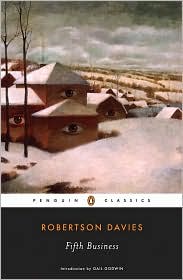
Fifth Business is a novel I actually started when I took a Canadian Lit course a few years ago (I was tricked into taking the class because the course was titled "ethnic literature" or something else misleading. It was a very disappointing class . . . both in material and instruction). True confession: never finished the book for the class but still got an A. Anyway, I picked up the book to give it another go because frankly I was too ill with the baby to make a trip to the library and I didn't have anything else to read. I must say that I did enjoy this novel better the second time around, although I still had a few issues with some of the author's characterizations. The feminist in me protested at the way he portrayed the women in his novel: there was too much angel/whore dichotomy in some (the narrator actually creates a "saint" out of one) and in general they are given very little autonomy or understanding. Davies does explore some interesting themes--such as the nature of our roles in this life (whether you are the main character of the "play" or merely fifth business-a kind of enabler role) as well as the nature of miracles and personal relationships. There are some charming characters as well as very imaginative ones . . . but the overall feel I got from this book was dissatisfaction. Perhaps I didn't appreciate this book fully because of my reading strategies: I have a hard time not reading from a feminist/Marxist perspective. If you read from either a Freudian or Jungian perspective, you may enjoy it more. Or if you read from just a readers response . . . you may have a better shot. If anyone out there disagrees with me, I would be interested to hear your perspective on the novel. Maybe I'm just missing something, and should give it yet another shot. Although I have a few other hundred novels in my queue I think I'd rather tackle first . . .

In this novel, I was not disappointed. Alice Walker does an outstanding job of creating complex, interesting, and sympathetic characters that grow and struggle . . . and sometimes overcome. This book had me thinking, and feeling, and I couldn't put it down. I guess this isn't such a big surprise since this was the genre I became most interested in while I was studying at University. There are psychological questions that come into play--from the many faceted ways the main character responds to the abuse she experienced, to the way Black masculinity is portrayed, to the nature of love and how we love. I felt that this book deserves the praise it has received . . . and transcends the movie that was made about it. Although Oprah was pretty funny for once. There is so much more that I could say about this book, but with the time and energy and mental capacity I have at this moment I couldn't do it justice (ask me again in a few months when my baby is sleeping through the night) so I will leave it at this-- Good Read.

While I was on bed rest, my mom let me borrow a copy of Left to Tell to pass some of the tedium on the couch. This was one case where I recommend skipping the forward and just reading the book. In my personal opinion the guru who wrote the forward was kind of weird and creepy . . . but maybe that was just the terbutaline talking. Anyway--Left to Tell is a non-fiction account of a survivor of the genocide that happened in Rwanda during the ethnic wars between the Hutus and the Tutsis. She is a woman of great faith who relies completely on her belief in God to get her through the terror she experienced and the subsequent loss. I had mixed feelings after reading the book. I wasn't as profoundly moved perhaps as many of the people I have heard praise the book. I do have deep admiration for her moral courage and her emotional strength, as well as the humanitarian work and goodwill she promotes. Spirituality is a difficult thing to convey in words, because it is such an intensely personal experience, so it can be difficult to translate--especially when not writing in your native language. Still, it was a good book, and I do recommend it.

Jonathan Rosen is one of my favorite authors--and guess what Randy, he's a white male! (My husband doesn't seem to think I can appreciate an author unless they are, as he puts it, "ethnically oppressed.") Rosen is a Jewish writer from New York, who really hasn't written as much as I would like :o). He does have a fairly new book out that is non-fiction about birdwatching, and if anyone could get me to read a book about birdwatching, it is Rosen. Joy Comes in the Morning is his first novel, and while I didn't enjoy it quite as much as Eve's Apple, I still think it is a very good work. Joy weaves together the experiences of an ailing man who is a holocaust survivor but attempts suicide to prevent living like a vegetable after a stroke, his son and a female rabbi. His characters are real, his prose is engaging, and I actually didn't resent the way he portrayed his female main character. What I think I appreciated most about this novel was the conversation about faith, and what it means to live "religiously" and still authentically. While I disagreed with some of the theological premises of some of the characters (particularly in the areas of premarital sex), I found the conversation itself worthwhile. This was another book I couldn't put down, and made me feel inspired in my own writing--which is far too sparse these days.

Thursday, January 29, 2009

Babies Make Things Shorter


I've been writing more poetry since I got pregnant. I haven't suddenly become more abstract or sentimental, but I do have less time. So . . . novel writing has become short moments while feeding the baby or while he's napping, and brainstorming has turned to verse.

Here are a few that I've been working on recently. There is music that accompanies the lullaby--ask Randy and he'll sing it for you. That being said, I may have to tweak some of the verse to make the music fit. The last selection is something I actually wrote a while ago in a poetry class, but I ran across it the other day and it made me smile. Feel free to add any (constructive) criticism, as I am not part of any writing groups at the moment and could use any feedback available. (That means you, Krystal!)


Bavarian Winter

Looking back now
I see two people standing there
holding hands in the rain.
It's hard to know now
whether we were coming, going
meeting once more to try again
or parting

I only remember a vague uneasiness
a chill in the street lamp, settling over
the pavement and me and you--

But your hands were warm
like the last long evenings of summer
or the times when we laughed
over all the stupid games we played
in the kitchen, over steaming pots
and pasta

I don't remember how or when
things changed
Just the seasons of wind and ice
and too late springs
the long lazy summers apart
but still we waited.

Holding hands on other streets
in other mists
Your hands warming mine
Laughter caught in the damp air
around our faces

Wesley's Song

hands so small
eyes so bright
you hold my heart
as I hold you tight

I would protect you
from every harm
cuddle you close
through every storm

So sleep my love, till
with the dawn above
the sun will shine through
the warmth of my love

Small awkward smiles
rain down on me
The sweetest rewards
are given for free

Darkness will come
but you need not fear
I will be there
to dry every tear

So sleep my love, till
with the dawn above
the sun will shine through
the warmth of my love


My Sexy Little German Man

"Bring a little German home with you,"
He said, with a wry smile
And eyes that laughed at his own jest
The over-used joke between us was not so funny
Anymore, but merely one more way to say
I love you.
I pictured comical hats and lederhosen
On a miniature man
Waiting on some cobblestone boulevard
Hip jutted out, eyes scanning the street
Like some elfin hooker, looking for a date
With me.
When I came home that night, I forgot
To bring the German--
What I brought instead was half-Italian,
One quarter Irish, an eighth French
And all mine.

Thursday, February 21, 2008

Book Review: Praisesong for the Widow

Praisesong is the first novel I have read by Paule Marshall. Through the course of my studies in African American Women's Literature, I have read various pieces of criticism by and about Paule Marshall, but I had yet to get around to her literature. I picked this book up two days ago (my bookshelves are filled with books I am anxious to read) and I have been enthralled from start to finish. As I read her work I was reminded of the experiences I had reading other books, such as Mama Day by Gloria Naylor, and Their Eyes Were Watching God by Zora Neale Hurston. All these novels--all extremely moving and excellent fiction--deal with ancestory, love, and destiny--and how these three things are irrevocably intertwined. Marshall does a fabulous job of keeping her narrative focused and relavent, all the while creating a deep dreamlike environment for the reader to lose themselves and experience another world. I love reading books like this so much because they make me feel connected to the diaspora of humanity, with the universal nature of feminism, with empathy, with experiences that are not mine but that I can still connect to.

Praisesong takes the familiar situation that Lorraine Hansberry captured in her play, "A Raisin in the Sun," of an underprivilaged black family living in abstract poverty, and then finishes the story where Hansberry left off. What happens to us when we let our circumstances dictate who and what we are, instead of letting the most fundamental part of our souls thrive, no matter our circumstances, good or bad--rich or poor? Richard Wright answered that question for himself in Native Son, with a polemic that is intended to be at once terrifying and real. Marshall does not take up the same themes of overt violence, the "ego" gone out of control--but she captures something very powerful in a very feminine way.

I highly recommend this book. You would definitely like it if you like anything by Toni Morrisson, Zora Neale Hurston, or Gloria Naylor.

Monday, February 11, 2008

January Book Reviews

After a long drought of reading for me (Christmas projects took up all my spare moments in late November/all of December) I devoured a couple of books last month. They are both best sellers and one won the Pulitzer, so I thought I'd review them for those of you in to literature.

Evening by Susan Minot was beautifully written. I was familiar with the film version that came out to limited release this last year (the screenplay was done by Michael Cunningham, and was materially different than the book--still a fine film in its own right) and on the special features of the DVD (thank you Redbox) I saw an interview with the author, and my interest was piqued. Her writing style is very spare--reminiscent of many of the mid 20th century author's styles (Hemmingway, Faulkner) but used in a very post-modern feminist way. Much of the prose reads like a kind of poetry--think Virginia Woolfe meets Sandra Cisneros--and I was fascinated and impressed with this poetic version of stream of consciousness. Overall I was very impressed with the quality of the novel. It dealt with very poignant issues without becoming overly sentimental, and I felt that the characters were believable and real--which I had been disappointed in a few of my previous reads. I would recommend this to people who can handle or even like novels with non-traditional prose, and don't mind shifts in time and/or perspective. If you like the novels The Heart is a Lonely Hunter by Carson McCullers or Caramelo by Sandra Cisneros, I think you would like Evening.
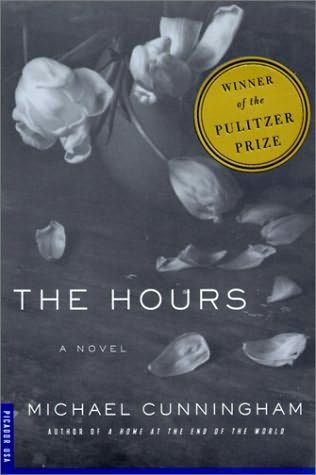
The next book I picked up was related by the association of the two authors--Michael Cunningham wrote the screenplay for Evening, and I was familiar with the film version of The Hours. I studied Virginia Woolfe a fair amount in various British Literature courses, and I firmly believe that before either seeing the movie or reading the book, a familiarity with Woolfe's Mrs. Dalloway is absolutely necessary. First of all, Mrs. Dalloway is a spectacular piece of fiction--Woolfe's language is exquisite and I think the concept of the novel is pure genius. Cunningham does a superb job of capturing many of the elements from Dalloway in The Hours--and to get the full effect you really must read the book. Something that might turn some people off to the novel: Michael Cunningham deals extensively with homosexuality in his work. As a gay writer he sees the world from that perspective, and it is an obvious factor in his work. I studied enough "queer theory" (yes, that is the technical term for it) in my university studies not to be fazed by homosexual themes/characters--so I thoroughly enjoyed the novel. It was very well written, and I wholeheartedly agree that it deserved the Pulitzer. Having given that footnote about Cunningham's . . . gayness . . . if that is what you want to call it, The Hours isn't about homosexuality. It is about dealing with loss, living with mental illness, love, and what the price is of living a full life. The themes are deep and very relevant for all of us, no matter our religious affiliation or sexual orientation. If you liked the novels Possession by A.S. Byatt or Eve's Apple by Jonathan Rosen, I think you would enjoy this novel.

Monday, October 8, 2007

Book Review: Possession by A. S. Byatt


I am going to pull a little copycat here, and do a book review of the latest one I've read. Possession is fantastic--especially if you are into literary fiction. It is poetic--literally--she mimics the British romantic poetry (Romantic being a literary period like modern or Victorian, not indicative of subject matter) of Browning, Barrett and Wordsworth as she creates fictive literary greats of the eighteenth century. It slips in and out of modern life and eighteenth century life seamlessly. Her characters are believable, and her prose is absolutely gorgeous. I am excited to read more of her work, because I feel like I just stumbled upon something really great! For the light reader: She does get into literary theory--psychoanalysis, the French feminists like Cixous, as well as a little queer theory (that isn't a pejorative phrase, that's really what the scholarly field is called) because that is what her characters are dealing with. She makes them very believable scholars, so if that turns you off you probably wouldn't appreciate the book. It isn't too heavy with theory, but it is an element. Something I was fascinated with while reading this novel was all the reference to Norse mythology in the poetry of her characters. I'm not a mythology buff so I borrowed an Oxford edition from an old roommate and learning a little bit more. The mark of a good book for me is not merely that it grips me--which this one did--but that it actually inspires me--which this one did as well. I feel like a better writer, scholar and critical thinker for having read this work.